

The new Mercedes-Maybach S-Class
22 November 2020
Top chef Hélène Darroze reveals her take on home delivery
26 November 2020Richard Mille interview
T he luxury watchmaker takes time out from his busy schedule to talk about where he gets his inspiration and his enduring love of aviation
What would you say were the important characteristics of a great watch?
I don’t want to sound too lofty, but for me watchmaking is a serious affair with a philosophical aspect that is not only business driven.
A great watch needs to be a work of art as a machine and as a design, with both aspects totally and coherently integrated into each other as a holistic entity.
The inside, comprising the movement and all its details, should fulfil its required functions perfectly, but with the added requirement that it also does so elegantly, efficiently and with a beautiful design.
The exterior, the case and the more visible parts on the outside, such as the case, crown, pushers, sapphire glass and all these details, need to support and complement those technical aspects – also in a combined technical and visually pleasing manner.
We aim for the best of innovation and technique, with a strong identity, personality and a breathtaking finish, at any cost.

‘I have been in love with the technical side of aviation for many years.’

What was the reasoning behind the recent link with Airbus Corporate Jets in creating a watch?
I have been in love with the technical side of aviation for years and years.
It might be hard to imagine, but I often spend my free time looking through a collection I have of technical aircraft maintenance manuals, such as those made for Concorde, because I love the drawings and blow-ups they show; it is a form of art for me. For instance, the fins and vents of jet engines can be experienced as beautifully expressive industrial objects, if you are open to that sort of experience.
Airbus Corporate Jets brings the challenge of marrying design and technique to an even higher level in the way they view the entire plane itself as an additional empty canvas to fill with forms, ideas and concepts. This synergy, and the idea of creating something together with them, was hugely inspiring.
The world of aviation offers almost limitless inspiration, as a sector that is constantly seeking new materials and technologies that must encompass both the infinitely small and the infinitely large, like we see in the field of watchmaking. I also believe that bringing two different working cultures together is always productive.
Together with the designer at Airbus, Sylvain Mariat, we decided to retain the characteristic tonneau outlines from the collection, while combining them with the specific culture of Airbus Corporate Jets.
The result is a unique marriage of a highly complex movement within a genuine monument of aesthetics and technology.
It is no wonder that watchmakers have always lent their expertise to create tools for the aeronautics industry, ever since the first aircraft ever left the ground
What is the inspiration behind the look of the RM-50-02 watch and the materials used within it?
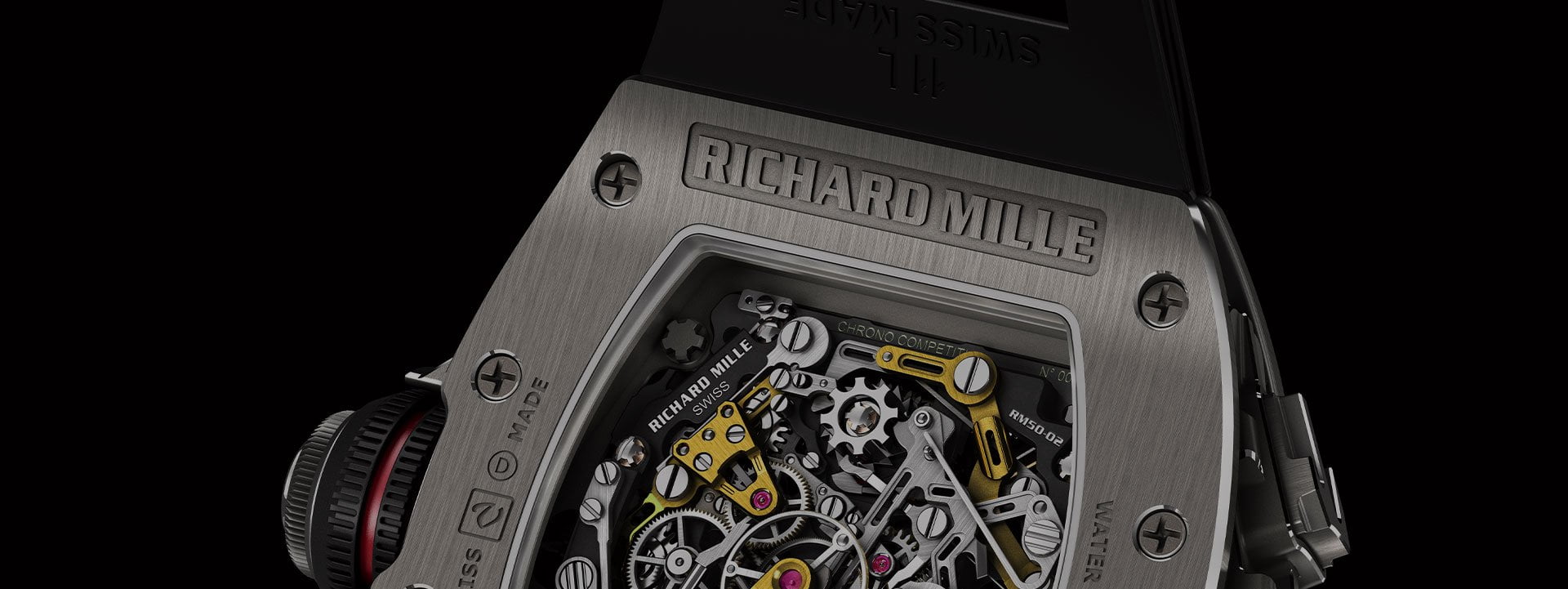
The first thing you notice is that the opening of the case on the dial side resembles the porthole window of the ACJ aircraft. The bezel surround of this window is made of a high-tech ceramic, ATZ, which is particularly scratch-resistant, together with an unchangeable colour. It is one of the hardest materials in the world after diamond, and we go to great lengths to shape it to fit like an inlay into the case construction of titanium-aluminium alloy (TiAl).
This case material is called an intermetallic alloy, because it has physical characteristics bridging metals and ceramics It has an extreme rigidity yet is much lighter than classical titanium alloys. Materials such as these are part and parcel of the aeronautical industry, as is classic titanium which I use extensively in the skeletonised, split-seconds chronograph movement. This is very unusual within the watch industry yet very much the norm in aviation.
What would you say characterises the enduring link between aviation and watchmaking?
Timekeeping is crucial to aviation on every level. It affects factors such as navigation, fuel consumption, security, speed measurement and just about everything that has anything to do with flight.
So it is no wonder that watchmakers have always lent their expertise to create tools for the aeronautics industry, ever since the first aircraft ever left the ground. We are continuing that tradition today and adding 21st century knowhow to the mix.
richardmille.comWords: DH
