

Dining: Wiltons: a British classic
8 January 2026
Fettercairn – oak-smoked Scottish smoothie
22 January 2026Mark of the Trident
Italian motor manufacturer Maserati celebrates its centenary this year and hopes to pass that milestone with flying colours
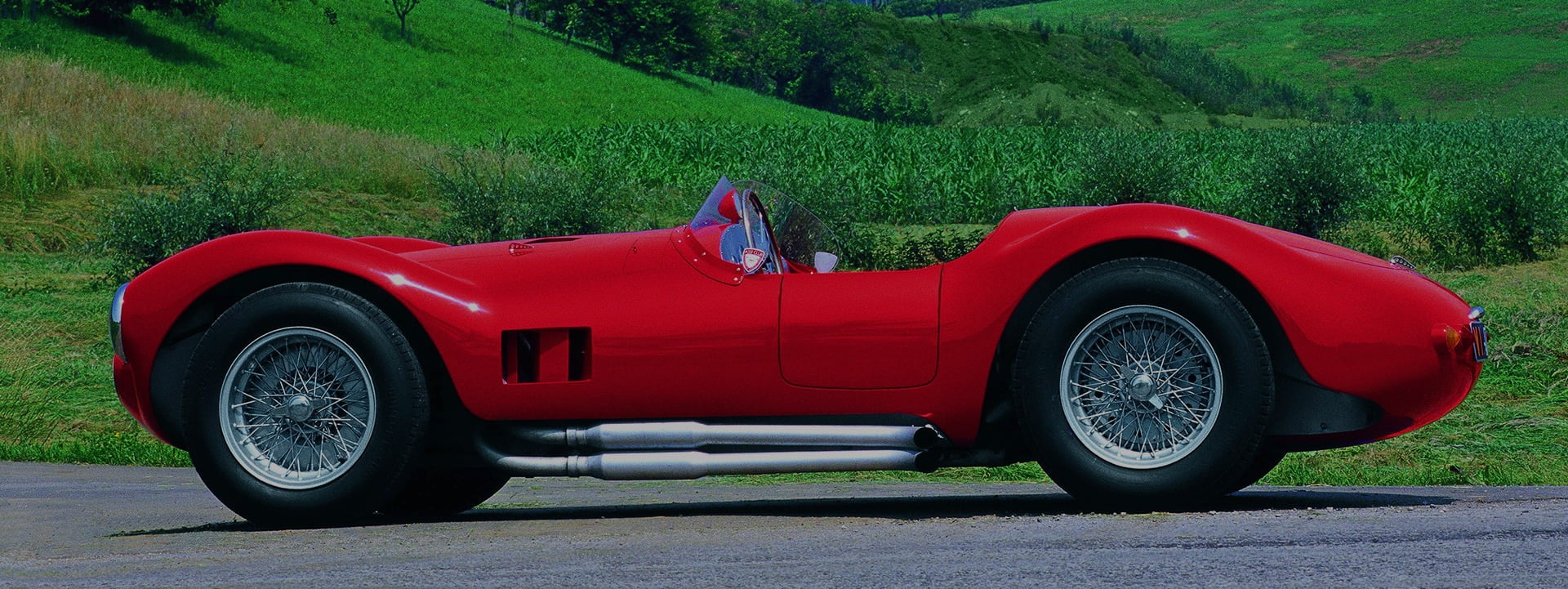
T here are few classic car marques that can match the long and illustrious history of Maserati. The Italian motor manufacturer has become a by-word for understated style and true racing pedigree. This year marks Maserati’s centenary – testament not only to the luxury motorcar’s enduring appeal, but also to the company’s survival instincts.
The Maserati car brand was first established in December 1914 when a young Italian, Alfieri Maserati, joined forces with his five car-mad brothers to found the Società Anonima Officine Alfieri Maserati in Bologna.
Alfieri, the son of a railway worker, had cut his teeth working as a mechanic and racing driver with the established motor firm Isotta Fraschini and harboured ambitions to forge his own path in this new exciting sport.

But dark storm clouds were gathering and in 1915 Alfieri and his brothers faced conscription into the army and the horrors of World War I.
Even with Italy at war, the Maserati brothers continued to stake out their motoring dream of building and designing a racing car that would take on the world.

Alfieri got valuable engineering experience by assembling the engines of combat aircraft and even patented a high-performance spark plug. It was the same spark plug used by the Italian poet Gabriele d’Annunzio during his daring propaganda air raid on Vienna in 1918.
At the end of the conflict Alfieri designed and raced Diattos, while his brothers continued to service cars for Isotta Fraschini. So it was not until 1926 that the first true Maserati was born. It was called the Tipo 26, designed by Alfieri, who raced it to victory in the Targa Florio.
It also sported the now famous Maserati trident created by Mario Maserati, the brother who had the least interest in motor engineering.
During the 1930s, Maserati unveiled several record-breaking racers, including the 1929 V4, with its 16-cylinder engine, and the 1931 8C 2500, the last car designed by Alfieri before he died after an operation on his failing kidney in 1932.
He had lost his other kidney as a result of a horrific racing accident five years earlier in Messina.
In 1956 Stirling Moss won both the Monaco and Italian Grand Prix in a Maserati 250F

Without the dynamic leadership of Alfieri the surviving brothers lost control of the company and eventually sold their shares to the Orsi family which moved Maserati’s headquarters to Modena.
In 1939 the start of World War II meant the Maserati factory switched its resources to producing machine tools, spark plugs, and electric vehicles for the war effort.
As soon as the conflict was officially over the company resumed doing what it did best – building unbeatable race cars. One of the most successful was the A6. An A6 SSG was driven by legendary Formula One driver Juan Manuel Fangio, who steered it to victory at the 1953 Italian Grand Prix. He was also the driver of a 250F in 1957, when Maserati took home the World Title for the fifth time.
The 250F, with its breath-taking combination of streamlined beauty and raw power, caught the eye of other famous drivers too. In 1956 Britain’s Stirling Moss won both the Monaco and Italian Grand Prix in a Maserati 250F.
Walter Bäumer, a leading expert on Maserati and author of books including Maserati 300S and Maserati A6G 2000 Zagato, says: ‘No other car manufacturer ever had to face glory and disaster so often over such a long period like Maserati.
'Back in the 1950s, Maserati became successful with its race cars and ruled the 2-litre class with its A6GCS.
Then both the 300S-sports racing car and 250F Grand Prix-car became icons in automotive history.
They steamrollered the Ferrari opposition with their mighty and brutish 450S, the strongest front engine sports racing car until the Panoz appeared in the 1990s.’
At the end of the 1950s the Maserati team exited the world of Grand Prix racing on a high note to concentrate its efforts on the luxury end of the commercial motor market.

Many industry experts credit the introduction of the 3200GT in 1998 in helping the company turn a corner
In 1968, French auto maker Citroën bought the shares of the controlling Orsi family. Some of the most famous cars in Maserati history, such as the Bora, Merak and Khamsin, were produced in the early 1970s before the world oil crisis ravaged the motor industry.
Gas-guzzlers like Maserati’s high-performance vehicles were hit particularly badly and the company’s fortunes took a steep plunge. Maserati was only saved from closure by a bail-out from the Italian government.
By the late 1980s the company’s health had hardly improved and its owners turned to Fiat for long-term financial support. Many industry experts credit the introduction of the 3200GT in 1998 in helping the company turn a corner. Today, the firm is going from strength to strength with sales better than they have ever been.
Peter Denton, regional manager Maserati North Europe, says the Ghibli and Quattroporte are once again winning over new fans, this time in the highly prized markets of North America and China. Latest figures show that 15,400 cars were sold last year which Denton believes puts the company firmly on track to meet a target of 50,000 by 2016.
So who is the typical Maserati owner? Denton responds: ‘They tend to be businessmen ranging in age from their mid-thirties to late sixties. Usually quite independent thinking, they are often afraid to be seen as boring – so that their choice of car is distinctly different from anyone else.’
Bäumer puts it differently: ‘The late Giulio Borsari, mechanic at Maserati and later at Ferrari, told me once: “If you work for Maserati you became part of the family.”’ No doubt the same is true of the select band of Maserati owners who can afford to spend upwards of £50,000 on a piece of motoring heritage.
The highlight of the Maserati centenary year will be a record gathering of 100 vintage cars whose owners will be invited to drive them on a celebration lap of the famous Silverstone Grand Prix circuit.

The emergence of the 3500 is credited with taking the brand from the racetrack to the road
Maserati 8CM 1933-1935
The Maserati 8CM was one of the brothers’ first Grand Prix racing cars. It was a particularly powerful model with a 2,991.4 cubic centimetre, straight-eight engine capable of delivering 240hp at 5,800rpm in its most powerful version. However, its weak point was the chassis, derived from the slender frame of the Maserati 4CM 1100 and too flexible to manage all the power of the eight-cylinder engine, which initially impaired the car’s performance. The first model was completed as early as March 1933 and was driven to victory in the Tunis Grand Prix of the same year by France’s Raymond Sommer.


Maserati 250F 1954-1958
The Maserati 250F is one of the marque’s all-time greatest race-winners. With Juan Manuel Fangio and Stirling Moss at the wheel, the 250F achieved no fewer than 55 victories in its seven years in service with the Maserati racing team. A powerful 270 horsepower straight-six engine, extremely lightweight at just 650 kilos and two of the best drivers in the history of motor racing brought Maserati the World Championship in 1957.
The car had a top speed of 290kmh. Moss later described the 250F as the ‘nicest Formula 1 front-engined car I ever drove’.
Maserati 3500 GT 1957-1964
The emergence of the 3500 is credited with taking the brand from the racetrack to the road.
It was Maserati’s first car to be built on a large scale, but even so no more than 220 were built, all with a six-cylinder, 3.5-litre engine capable of producing 220 horsepower in its original version thanks to its three Weber carburettors.
The 3500 was subsequently modified to include a fuel injection system that increased its power to 235 horsepower: the Maserati 3500 GT therefore went down in history as the first Italian car ever to be fitted with a fuel injection system.
Words: Staff
