

Nature’s artworks: incredible fossils at auction
13 October 2020
Destinations: Kempinski Barbaros Bay, Bodrum
14 October 2020Leader of the Charge
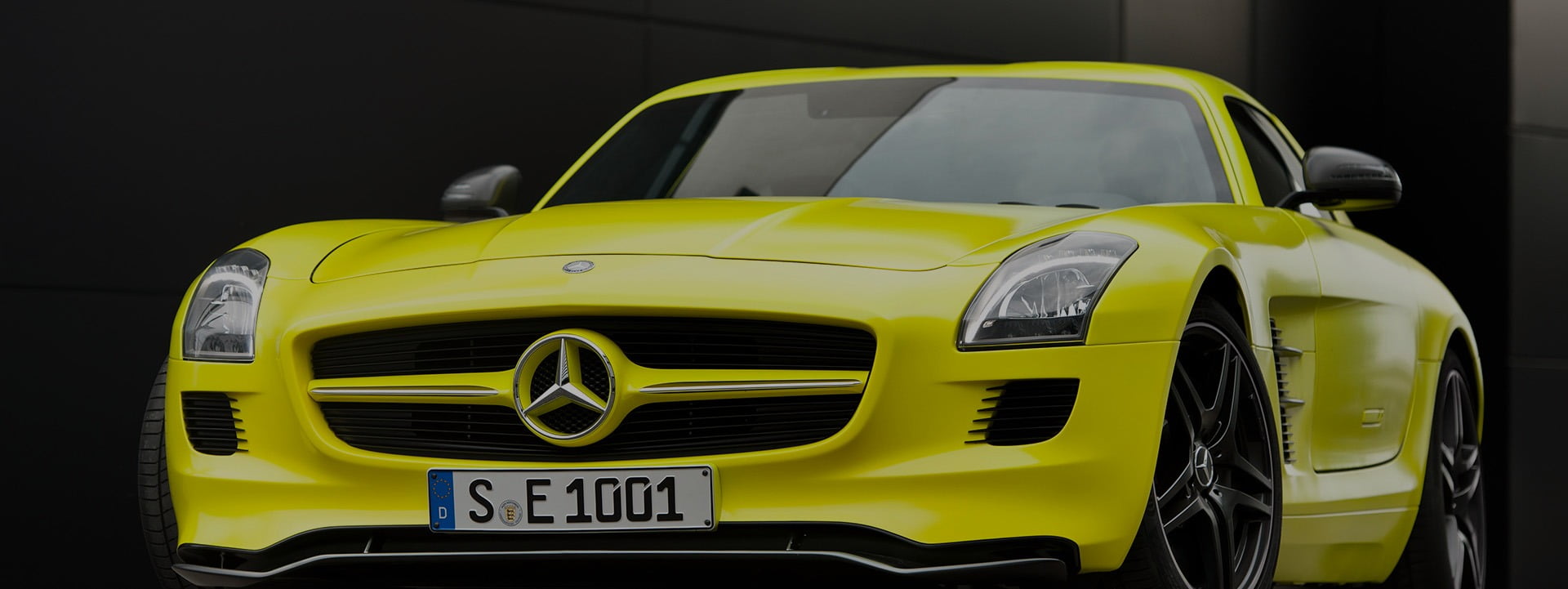
Mercedes’ new gull-wing coupé is a high-voltage pioneer in the supercar world
T he acceleration from 0-62mph (100kph) takes just four seconds. Top speed is limited to 155mph… although it could actually go a lot faster. With gull-wing doors and a citrus yellow paint-job, this new Mercedes is clearly in the supercar category.
Yet the SLS AMG E-Cell isn’t quite what it seems. It’s very different to any Lamborghini, Maserati or Ferrari. This is a supercar that causes no pollution. It creates no emissions. It doesn’t even make a noise.
That’s because the E-Cell is a completely electric super sports car. When it was launched at the end of 2012 it became one of the most advanced of a new breed of supercars that use alternative power to avoid the polluting effects of standard internal combustion engines.
The current trend among most supercar manufacturers is to research and develop cleaner vehicles. Some are experimenting with hydrogen fuel cells, others are focusing on hybrid combinations of electric and combustion engines. A few have produced all-electric vehicles. So far, many of these efforts have been hampered by a lack of grunt or glamour.
There’s no such problem with the Mercedes SLS E-Cell. This striking sports coupé is powered by a pioneering system of one electric motor for each wheel. This layout creates an electric version of permanent four-wheel-drive, with all the benefits of increased traction.
Each of these electric motors can rev up to a dizzying 12,000rpm and supplies its enormous maximum power of 525bhp and 649lbs-ft of torque immediately from a standstill. That huge torque figure is, incidentally, 170lbs-ft more than the petrol-powered AMG SLS.
On the road, that translates to hair-raising performance for the silent, zero-emissions vehicle. The SLS E-cell is only fractionally slower to 100kph than the SLS, which has a thirsty, noisy and polluting 6.2-litre V8 engine under its bonnet. The top speeds of the two cars are the same yet road-testers report that the E-Cell actually feels faster in the all-important mid-range acceleration.
Formula 1 driver David Coulthard was filmed testing the E-Cell prototype recently and was visibly shocked by the acceleration. ‘Awesome!’ he grinned. ‘You will not believe the performance. It’s even more responsive than the V8.’
It’s fitting that Mercedes Benz should have created this super sports car for the future. Karl Benz’s innovative ‘Motorwagen’ made the first proper car journey in 1888. Advance 125 years and Mercedes is taking a similarly big step forward.
The SLS E-Cell shows that the next generation of motor transport need not involve sacrifices to performance, pride or pleasure. Cars such as the Toyota Prius and Honda Insight were eco-motoring pioneers at the turn of the new century. Their buyers bravely accepted sacrifices of style and speed for the sake of saving the planet.

A press on the accelerator pulls the car from a standstill with only the sound of the tyres on the tarmac and, as speed increases, wind noise from door mirrors

After years of fine-tuning, the new Mercedes is much more environmentally sound than either of those early hybrids – and much more enjoyable too.
The whole body of the SLS E-Cell, for example, is made of carbon fibre-reinforced polymer on an aluminium spaceframe to reduce weight.
The shape of the body has been optimised from the petrol version to minimise aerodynamic drag and a regenerative braking system converts the electric motors to generators to recharge the car’s batteries when the giant ceramic and carbon-fibre racing brakes are in action.
The electric energy to provide such supercar performance is stored in high-voltage lithium-ion batteries sited strategically around the car for balance and an improved centre of gravity. They can be charged from a normal domestic power socket.
The batteries are liquid-cooled or electrically heated depending on climate. But they are heavy – they make the E-Cell 400kg (840lbs) heavier than the petrol-powered car.
This means, like those early hybrid vehicles, the SLS E-Cell will require its buyers to make compromises. The major one will be the limited range between recharges. The original prototype had an estimated range of less than 100 miles (160km) between charges. Since then Mercedes has tinkered with the car enough to suggest it can achieve around 130 miles or even more.
The electric energy to provide such supercar performance is stored in high-voltage lithium-ion batteries sited strategically around the car for balance and an improved centre of gravity
The driver will be able to select different driving modes, which could increase the range further. The most ‘economical’ mode only uses 40% power to preserve batteries. Other modes offer progressively more performance and hence deplete the batteries faster.
Inevitably, the cutting edge technology of the SLS AMG E-Cell comes with a supercar price-tag. It is likely to cost more than £150,000. The first batch will be sold ‘by invitation only’. Lesser customers may have to wait until the 2014 model year, although Mercedes is already planning a roadster version too. It is not known yet whether all the cars will be painted the luminous lime colour of the prototype.
Drivers press a ‘Start’ button to fire up the four electric engines, but there’s no sound or vibration. The only sign that the car is ready for take-off is the unique dashboard bursting into colourful life. Instruments show the state of the battery and range remaining. A 25cm touchscreen infotainment system does the rest.
A small press on the accelerator pulls the car from a standstill with only the sound of the tyres on the tarmac and, as speed increases, wind noise from door mirrors.
The thrust is silent but constant – a surge of power uninterrupted by gear changes. Keep your foot on the throttle and within 11 seconds you are travelling at 124mph.

Cornering is precise thanks to specially adapted suspension that uses sophisticated Formula 1 components to cope with the weight of batteries in the nose and tail.
The four-wheel-drive pulls the car out of a corner with real gusto and, when necessary, the enormous racing brakes bring the machine to a halt within seconds.
Cornering is precise thanks to specially adapted suspension that uses sophisticated Formula 1 components to cope with the weight of batteries in the nose and tail

Electric sportscars have started making a small but significant impact across the motoring world.
The Tesla Roadster and Venturi Fetish are both small, light, fast two-seaters… and both are very expensive. The Tesla has been the leader of the pack, with a range of over 200 miles and a 0-60mph time well under four seconds.
Buyers can also choose hybrid sportscars such as the Fisker Karma and Honda CR-Z that use a standard engine combined with electric power for cleaner, more economical progress.
Meanwhile, other German car-makers are rushing to keep up with Mercedes. Audi is working on its own all-electric supercar, probably to be called the R8 e-Tron although there is no launch date yet.
Porsche’s R918 coupe is being developed with a V8 petrol engine and two electric motors.
BMW’s entrant into the eco-supercar arena will be a diesel/electric hybrid coupé that is scheduled to be launched in Autumn 2013. Mitsubishi has announced that the next generation of its long-running Evo series of hot-rod saloons will be a hybrid.
The Evo XI will use a small, turbocharged petrol engine and electric power.
Most radical is the planned Koenigsegg Quant – which uses a photosensitive paint to capture solar energy to help power its all-electric drivetrain. This innovative creation has a range that is claimed to be over 300 miles and a top speed around of 170mph.
The prototype has already been seen at a number of the world’s motor shows, but no date has been set as yet in terms of larger scale production.
Words: Staff
