
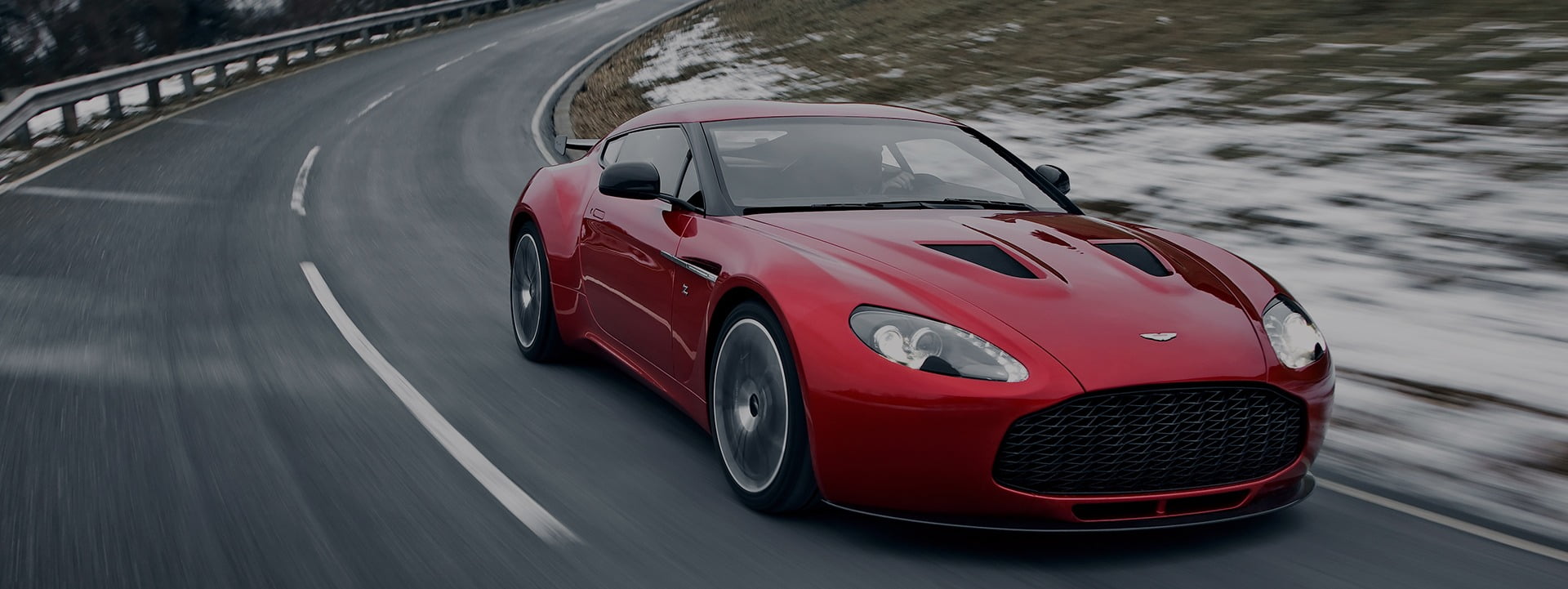

Brief encounters: rent a supercar and enjoy
18 October 2020
Driving: Maserati’s eye-catching GranTurismo Sport
19 October 2020A Hundred Years at the Top
Aston Martin celebrates its centenary this year. In that time the company has produced some of the finest British cars of all time
H istory could have been different if it hadn’t been for a steep slope in the English county of Buckinghamshire. Without it, one of the world’s most famous automotive brands might still be called Bamford & Martin – surely a name more worthy of a company that made combine harvesters rather than epic roadsters?
Lionel Martin and Robert Bamford set up their enterprise in 1913 at Henniker Mews in Chelsea, but when Martin won the Aston Clinton Hillclimb on 16 May 1914 the pair decided to rename their marque Aston Martin.
Long forgotten today, this event was an important attraction for motoring pioneers between 1904 and 1925. It involved drivers taking their vehicles as fast as possible up the incline and was a test not only of the skill of the man at the wheel, but also the capabilities of the motor car.

That Aston Martin excelled in this discipline was a fact that was not lost on the motoring enthusiasts of the day. Despite the outbreak of World War I and Bamford’s departure from the company in 1920, it established itself as a brand to be desired.
One of the cars of that era still survives today in the shape of a 1922 model called the A3, which has been restored to its original glory by the Aston Martin Heritage Trust.

Early Astons such as this were small, compact sports cars powered by single-cam, four-cylinder engines. They relied on limited weight for speed, not a large amount of horsepower.
Another surviving example of the pre World War II era is the ‘Ulster’, long in the bonnet, tapered at the back, two dominant headlights to the front – a car that would look perfectly placed when parked up on the perimeter of a Battle of Britain airfield and, indeed, it was a favourite of a certain type of well-heeled officer during the UK’s finest hour.
A similarly famous survivor is the 1939 Atom, brainchild of the then-boss of the company, Gordon Sutherland. With its curving bonnet, low-level grille and compact, four-door body, the Atom still looks futuristic to this day – as if it could have emerged from the pages of a Dan Dare comic.
In 1941 specialist magazine The Autocar reported: ‘The saloon body breaks with British car convention as universally understood in 1939... see it as the comfortable, convenient sports-type car of the future.’
Early Astons were small, compact sports cars powered by single-cam, four-cylinder engines


Unluckily for the company the launch of the Atom coincided with the beginning of World War II and, by the end of hostilities, Sutherland was struggling for money and had to put the company up for sale.
The new owner was David Brown, an entrepreneurial Yorkshireman whose family tractor business had seen profits rise during the war and who fancied a more glamorous foray into the automotive sphere.
He bought Aston Martin for £20,500 and, the following year, paid £52,500 for Lagonda. His era at the helm coincided with the production of the most famous of all the Astons. The best possible publicity was to come from an unexpected source – the writer and former intelligence officer Ian Fleming. His seventh James Bond novel, the 1959-published Goldfinger – placed the eponymous secret agent behind the wheel of a ‘DB III’. There was an element of artistic licence to this arrangement – the car was in reality called a DB MkIII.
The film of the book hit the UK’s cinema screens five years later and Sean Connery’s incarnation of Bond was depicted driving the then-latest Aston, a DB5. It was arguably the most famous vehicle ever to make an appearance in the films and possessed a range of futuristic gadgets, including a tracking device, bullet-proof rear screen and ejector seat.
Despite such cinematographic heroics, however, Aston Martin struggled to make money and, in 1971, it was sold once again. This sale was followed shortly afterwards by the oil crisis and the company went into receivership in 1974. All 500 of its staff were made redundant.
A consortium including Aston owner Alan Curtis managed to save the day and the business continued until 1981, when it was taken over by a private company headed by Victor Gauntlett.
These were rollercoaster times for the company, with one of the highlights being the restoration of the link between Bond and Aston Martin. Timothy Dalton drove a V8 Vantage Volante in the 1987 film The Living Daylights.

The DB7 and the Vanquish put Aston Martin back on track and it has barely looked back since

The Vantage and Virage, though, while powerful, were beginning to look decidedly old-fashioned.
They also took too long to build in the context of the day. Transformation came with additional funding from Ford and the chairmanship of Walter Hayes.
The DB7 and the Vanquish of 2001 put Aston Martin back on track and the brand has barely looked back since – except to gain a hint of inspiration from the shapely models of yesteryear.
The DB9 used a new ‘VH’ platform that’s still part of the Aston strategy. This has helped Aston compete with the major players such as Porsche with much smaller resources and has arguably kept the company afloat. In 2012 the brand notched up worldwide sales of 3,800 cars (it sold a mere 42 in 1992).
As to what the next 100 years may bring, who knows? In December 2012, Italian private equity firm Investindustrial took a 37.5 per cent stake in the company for £150m and Aston has also announced details of a technical partnership with AMG, the high-performance arm of Mercedes-Benz.
It’s all a far cry from the days of thrashing an open-topped motor up a Buckinghamshire hill, but for this most British of brands it could mean the future becomes more certain than it has perhaps ever been. In keeping with the great James Bond himself, Aston has been in some pretty tight spots, but it always seems able to pull off something astounding to save the day.
Words: DH
