

Fettercairn – oak-smoked Scottish smoothie
20 August 2026
Tswalu Loapi: The space below the clouds
24 August 2026Grape Expectations
Krug’s Grande Cuvée is one of the finest champagnes in the world. So what’s the secret of its success?
T
he liquid drips, painfully slowly, from pipette to measuring cylinder as I scan a sequence of crossed-out and rearranged figures on a sheet of paper in front of me. On a chalkboard at the front of the room, a series of columns and rows suggest percentages and complex ratios which may – or may not – be helpful.
Krug’s Grande Cuvée is one of the finest champagnes in the world. So what’s the secret of its success?
T he liquid drips, painfully slowly, from pipette to measuring cylinder as I scan a sequence of crossed-out and rearranged figures on a sheet of paper in front of me. On a chalkboard at the front of the room, a series of columns and rows suggest percentages and complex ratios which may – or may not – be helpful.
Either side of me, brows are furrowed, hands trembling slightly as they reach for one of a couple of dozen mysteriously labelled bottles on the tables around the room.


We might be conducting hazardous chemical research, perfecting some new titration technique or risking mutilation and permanent disfigurement by mixing a number of inherently volatile substances. Instead we’re making champagne.
And not just any champagne – Krug Grande Cuvée.
If you know anything about how that golden liquid and those tiny bubbles get into a bottle, you might think it’s simple enough. Grow some grapes, pick them, squeeze out the juice, ferment it, stick it in a bottle with a bit of yeast and sugar to make it fizzy, wait a bit longer, then get rid of the sediment and add a final bit of something sweet to make the end result balanced. Isn’t the rest just a triumph of what the French call ‘le marketing’?
Well, that’s why we’re here. Krug champagne’s cellar-master, Eric Lebel, has given us a pep talk on how to put together the blend for one of the world’s most famous champagnes, pointed us in the direction of a couple of dozen samples of ‘vins clairs’ (still wines) and left us to it.
It’s a fiendishly complex and – to judge from the results – easily botched task
It’s a fiendishly complex and – to judge from the results – easily botched task, but we’re doing the ‘for dummies’ version. When Lebel and his colleagues put together Krug Grande Cuvée NV once a year, that couple of dozen sample bottles is multiplied many times to well over 350. Grande Cuvée is a non-vintage champagne, which means that it’s based on the wines of more than one harvest. But it still has to be recreated every year, using the latest wines to display the signature Krug style in a way consistent with previous bottlings.
Let’s take 2013 as an example. Lebel and his team start off with the wines of the vintage – about 220 of them. Represented are the trio of classic champagne grape varieties: Chardonnay, Pinot Noir and Pinot Meunier. The final blend, on this occasion, will have about 35 per cent Chardonnay, 43 per cent Pinot Noir and 22 per cent Pinot Meunier, but there’s no recipe – it all depends on the wines of the year and how they work together.
Beyond grape variety, it’s all about location. The 2013 Chardonnays from Le Mesnil-sur-Oger have a smoky, gunflint character with less overt acidity and big citrus fruit – but those from Villers-Marmery on the Montagne de Reims exhibit a creamy roundness that is richer and brighter.
Pinot Noir from Ambonnay, meanwhile, has a distinctive, pin-sharp strawberry and raspberry fruit character, while the fruit from Verzenay is more rounded, but also has a rather beguiling mineral character.
And Pinot Meunier – in grape variety terms, often the unregarded understudy in Champagne – has a lovely texture and weight in the mouth in a good year like 2013 and from a prime site like Saint-Gemme.

Krug keeps a stock of about 150 reserve wines dating back to the late 1990s that are used to ‘fill the gaps’ left by the wines of only one vintage

Through all of this, Lebel has in mind the overriding style of Krug and, because of the nature of Grande Cuvée, he’s after lots of character and personality. Were he making champagne for, say, Louis Roederer or Taittinger, his priorities would be entirely different.
But we’re slightly ahead of ourselves. Where does this wine come from? Krug has a network of grape growers throughout the Champagne region, but doesn’t buy from just anyone. Before a new grower is accepted by the house, they visit the team at Krug, Lebel goes out and looks over their vineyards and there are long, long discussions about picking dates and the work in the vineyards. Only when everyone is satisfied that they share the same philosophy is the relationship consummated in a contract to buy grapes.
So much for the wines of 2013, but to make great non-vintage Champagne you need more. You also need reserve wines from past vintages.
Recent investments have allowed Krug to keep a stock of about 150 reserve wines dating back to the late 1990s, which offer a variety of permutations to add complexity and ‘fill the gaps’ left by the wines of only one vintage.
Ask a connoisseur what’s special about Krug, and many will mention the fact that new wines spend roughly 2-4 months in oak casks. But is this really the key to Krug’s unique style? The wood used is between three and 40 years old, so its impact on the wine is subtle – any obvious flavour of ‘wood’ in the tasting room is regarded as a fault.
Instead, far more crucial to the final flavour are two key factors: Lebel’s quest for personality and character in the tasting room, and the wise use of reserve wines.
Only when everyone is satisfied that they share the same philosophy is the relationship consummated in a contract to buy grapes
Krug’s obsession with these dates back to the 1950s, when Paul Krug decided to keep them, but needed to ensure they were fresh. So he adapted techniques used in the dairy industry and put them into stainless steel – a pioneering idea at the time which has since become all but ubiquitous among producers.
The result, in Krug Grande Cuvée is a wine that can have tiny, elusive variations from year to year, but retains the essential character of the house – a richness, but combined with an ethereal freshness and finesse that is sometimes overlooked.
In other words, a great champagne.
And our own efforts at creating Grande Cuvée? Well, the exercise drives home the message of just how infernally difficult the job of a cellarmaster is.
It's why someone in Lebel’s position needs decades of experience, combining immense scientific rigour with an almost alchemical ability to conjure great wine.
Having heard his excessively generous verdict on our rather ham-fisted efforts to replicate his monumental efforts, I can also say that he’s an extremely kind man. But not one who’s in a rush to offer a winemaking job to a jobbing journalist any time soon.
Words: Staff

The Exceptions
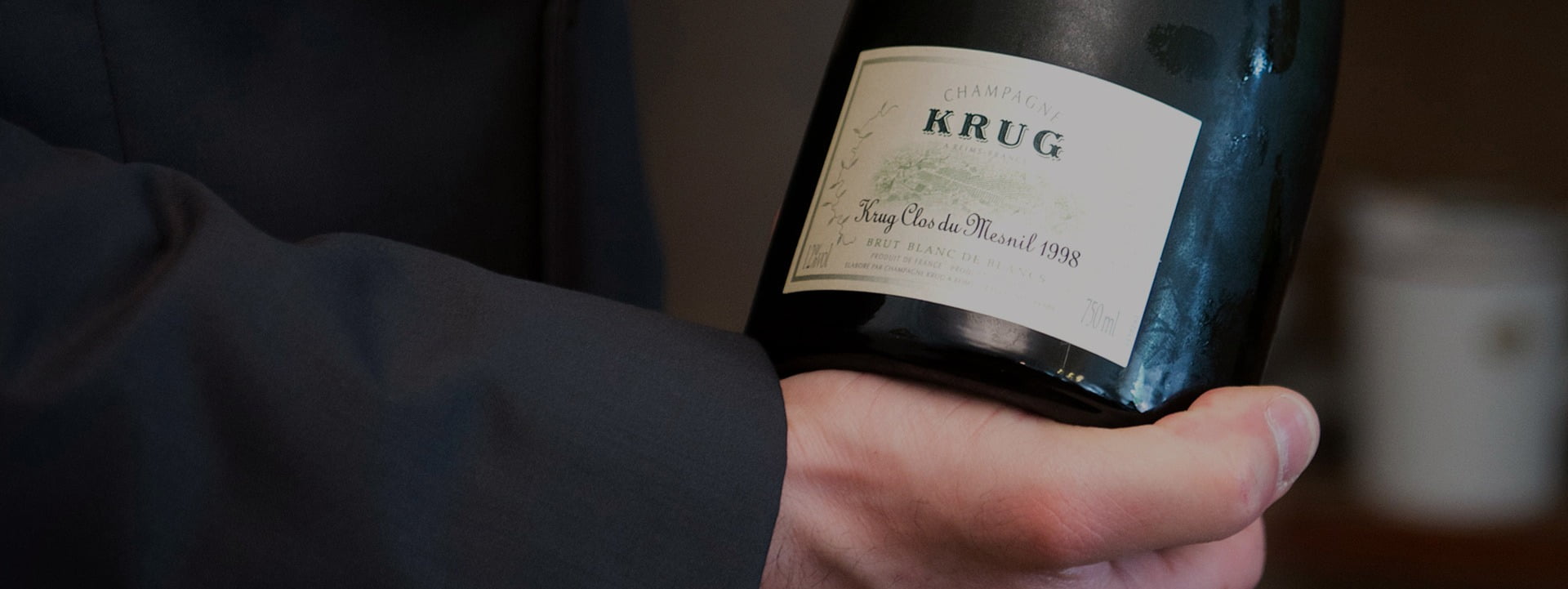
The principles underlying the philosophy of Krug are embodied in a humble notebook containing the jottings of the house’s founder, Joseph Krug. Here he talks about making just two wines: Cuvée 1: the best champagne you can make every year – in other words, Grande Cuvée; and Cuvée 2: the story of one year (Krug vintage).It’s a simple vision, but one from which Krug has never really deviated. Except, that is, for Clos du Mesnil and Clos d’Ambonnay: single vineyard, single vintage – there’s no blending at play here to speak of, just the ultimate expression of two particular plots and one year. Clos du Mesnil 2000
(about £500 per bottle from fine wine merchants)
Sourced from a walled vineyard in the sought-after Chardonnay enclave of Le Mesnil-sur-Oger, is Krug Chardonnay in microcosm and par excellence: rich but precise, with jasmine and light spice undercut by honey and some darker notes. The 2003 has just been launched, so look out for that too. Clos d’Ambonnay 1998
(typically £1,250 or so a bottle from fine wine merchants)
It offers the same character study of Pinot Noir: walled vineyard, essence of Krug Pinot character. It shows sumptuous red and black confit fruits in richly creamed brioche and is a champagne of immense structure and complexity. It provides muscle to set against the precision of Clos du Mesnil.