

Ausounds – premium audio products from LA
30 October 2020
Driving: collecting Formula One memorabilia
2 November 2020Men at Arms
The 200th anniversary of the Battle of Waterloo was marked by a grand re-enactment that provided a dramatic insight into a day that changed Europe
T here is an air of serious preparation among the French Imperial Guard. Dressed in tall forage caps, waistcoats and thick white or blue trousers, men are busy cleaning muskets, making cartridges repairing accoutrements. Many display huge moustaches, gold earrings and the occasional scar of battle.


Behind their white canvas tents is a seemingly unremarkable Belgian farmhouse – the Ferme du Caillou. Appearances in this case are deceptive, however, for the farm has a rather unusual history – it was here that Napoleon Bonaparte spent the night before the Battle of Waterloo and it would later act as the emperor’s headquarters on 18 June 1815 – the day he would finally see his empire unravel in a Belgian cornfield, his troops overcome by a mixed force of British, Prussians, Dutch and Belgians.
Today it is home to a small museum and its orchard is providing temporary accommodation to several hundred re-enactors, who are some of around 5,000 who have travelled here to re-stage the battle in front of around 60,000 spectators.
Some 200 years ago this would have been the bivouac of Napoleon’s Imperial Guard – his most experienced and trusted troops – and the re-enactors are doing an impressive job of recreating the look and feel of an early 19th-century military camp.
‘When you see 100 men with muskets fire a volley from 40 or 50 yards you’re left wondering how anyone facing it could have survived.’
While the actual battle began at around 11am, the re-enactment is scheduled for the evening, leaving tens of thousands of spectators to walk the battlefield and muse on the events that unfolded here.
Napoleon’s former HQ is not the only building to have survived since 1815. The Chateau d’Hougoumont was a large farm that formed a key strongpoint in the Allied defences and has recently benefited from a £3m restoration project.
The majority of the Allied re-enactors are encamped near its walls – their numerous different uniforms provided a rainbow of colours. It is an impressive gathering, but nothing compared to the numbers of soldiers who were actually involved 200 years ago – 72,000 in the French army, 68,000 in the Anglo/Dutch and 50,000 in the Prussian.
Among those who camped at Hougoumont is Chris Shaw, a vastly experienced British re-enactor, whose hobby has taken him across many Napoleonic battlefields and who plays the part of a rifleman in the 95th Rifles.


Like many of his comrades, Shaw is an enthusiastic historian – he is also chairman of the Shorncliffe Trust, a charitable organisation dedicated to creating a heritage park and education centre at the Rifles’ Napoleonic-era garrison in Kent.
He sees his re-enactor role as multi-faceted – helping to educate the public about a period of history that was crucial to the development of Europe and gaining insight into the military tactics of the time, while also commemorating the soldiers of all nations who fought at Waterloo and other battles of the era.
'There were something like nine million rounds of ammunition fired during the Battle of Waterloo. Those musket balls are still being unearthed today.'
‘We’re showing our respect for the soldiers who were here 200 years ago,’ he says. ‘When you see 100 men with muskets fire a volley from 40 or 50 yards you’re left wondering how anyone facing it could have survived.
'There were something like nine million rounds of ammunition fired during the Battle of Waterloo. Those musket balls are still being unearthed today and people will still be finding them here for years to come.’
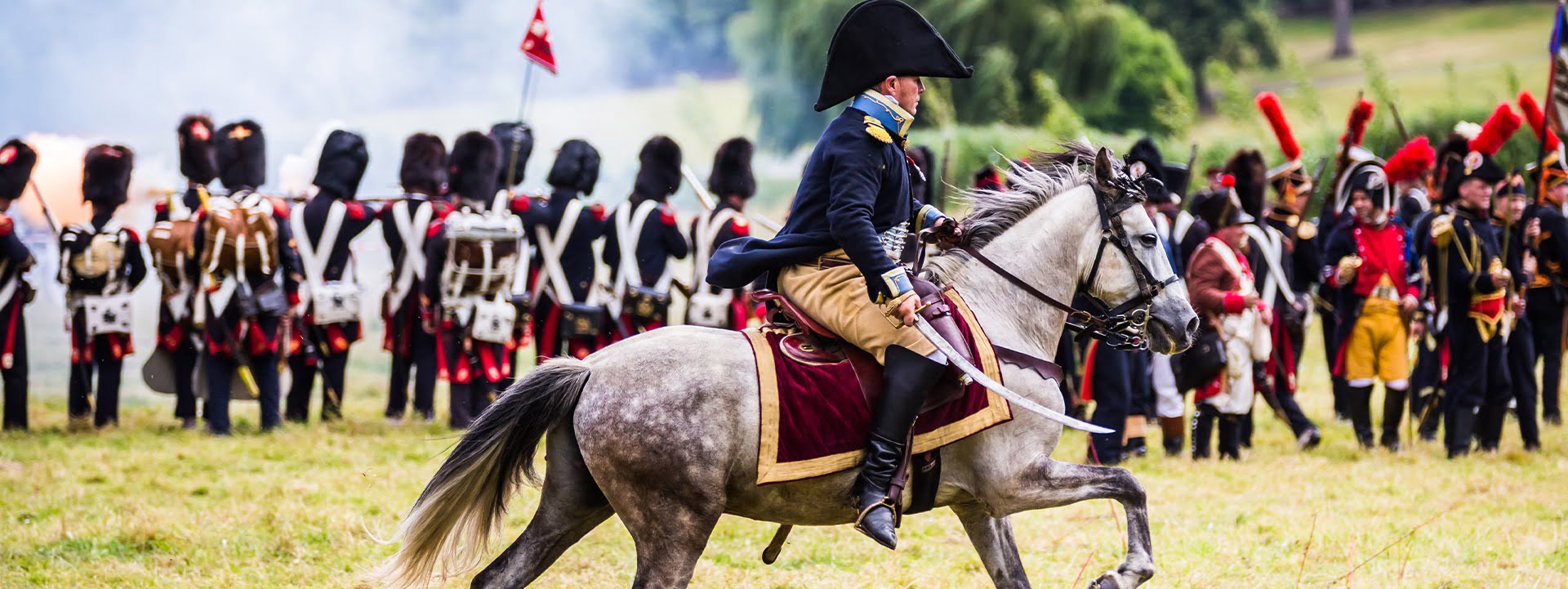
The re-enactment itself is carefully planned to resemble the actual event as far as it possibly can and it takes place on a segment of the battlefield that – then as now – is growing a crop of corn. Cannons roar and musket fire ripples out in volleys. Smoke soon cloaks the battlefield and it becomes difficult for spectators and re-enactors alike to tell friend from foe. The phrase ‘fog of war’ suddenly makes very literal sense. The noise is intense and parties of cavalry gallop about at high speed. They’re impressive in groups of 10 or 20 and give just a hint of what it might have been like to face the thousand-strong cavalry charges that happened during the actual battle.


Somewhere on the left flank, amid the smoke, Rifleman Shaw is roughly in the place occupied by the 95th 200 years ago.
It proves to be both an informative and an emotional experience, he says afterwards. ‘We got to our positions early, about an hour before the re-enactment was due to start. Everyone was chatting and enjoying a bit of banter and then gradually they all went quiet. High above a skylark started singing and everybody stopped and just listened. Similar birds would have been here 200 years ago and people at the real battle would surely have heard the same noise before everything began. It was an emotional moment.’
The re-enactors also gained other insights into what the battle would have been like for ordinary soldiers. Shaw adds: ‘I must have lost around half an hour where I can’t really remember what I did.
'All I did was load and fire my rifle, then move position and do the same thing. It all became automatic. And you realise how uneven the ground is and hard that makes it to run.
‘You can’t see what’s happening during a battle except in your immediate vicinity. A wider awareness of what’s going on is almost impossible.’

'Then there was the corn – which would have been higher in 1815 than it is today. It sticks to your clothes like velcro and really slows you down.’
It is these kinds of simple but often ignored insights that make re-enactment a valuable educational tool. A few hundred yards away from Shaw and his riflemen during the en-enactment was Duncan Miles, who – while English – takes on the role of an officer in the French 45th Regiment.
‘Through re-enactment you can add an extra dimension to the existing levels of knowledge,’ he says – citing the example of smoke from all those weapons.
‘You can’t see what’s happening during a battle except for the area in your immediate vicinity. A wider awareness of what’s going on is almost impossible.’
Miles has also realised the type of physical challenges that those real 19th-century soldiers would have faced. ‘We often imagine them being more sickly than people are today,’ he says, ‘but to carry the equipment they did, while surviving on very meagre rations and marching 12-15 miles a day, must have taken a lot of stamina.’
But the number of re-enactors and the massed ranks of spectators suggest there is also a more general interest in the Napoleonic era on show here.
Miles thinks it could all be linked to the man who gave his name to the era. ‘I think it’s the wonderful story of Napoleon and his family,’ he says. ‘Personally, I find it incredible that a man from a family of minor nobility in Corsica could rise to become Emperor of France and to rule most of Europe. Of his seven brothers and sisters he created three kings, one queen, one prince and two princesses. His life is a real rags-to-riches and back to rags again story, with marriages, love affairs and battles in between.’
He appears to have a point. At the end of the re-enactment, with the rain falling, the crowd’s biggest cheer is reserved for the man playing the emperor of the French.
Words: DH

This article was originally published in Halcyon magazine in 2015.
