
Beyond carbon: the J.Laverack Aston Martin .1R
30 June 2026
Destinations: England, the Lake District, Gilpin Hotel
2 July 2026Let the Ink Flow
From investment opportunity to the ultimate status symbol, popularity for exclusive writing instruments continues to grow
W hen The President of the United States, Barack Obama, signed his country’s health bill, a total of 22 specially commissioned pens were used to mark the historic political occasion.
It was part of a long tradition of the ceremony of signing; from rare quills and ink centuries ago for royal charters and declarations, to the specifically crafted fountain pens for political signings today. In an age of high-tech computer screens and the barrage of email, when many of us no longer rely on ink, it seems that more than ever the luxury pen can be mightier than the sword.

‘In a highly technical and largely anonymous world, people crave individuality as a counter-balance,’ says Antji Roder from the world-famous company Faber-Castell. ‘This has been most noticeable with the rise of high-end and exclusively personalised watches with mechanical movements.
'High-quality writing instruments are enjoying a similar renaissance to timepieces and are valued even more because they enable people to express their individuality just by writing with them.’
Above all, it’s the fountain pen that is king. ‘We have seen a resurgence of popularity in the past 10 to 15 years,’ says Andreas Lambrou, author of Fountain Pens of the World. ‘We have seen a greater production of vintage-style pens. Nowadays the manufacture is very strong in Europe.’

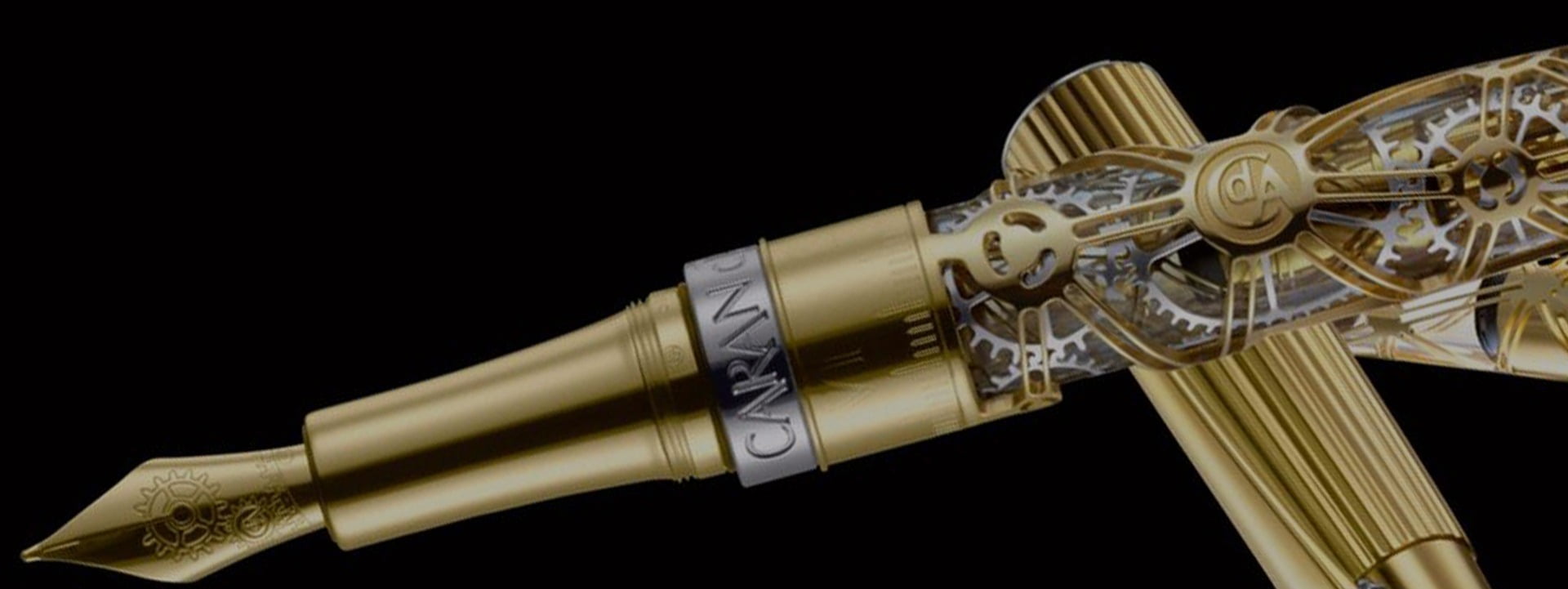
It is the exclusivity, the uniqueness of premium fountain pens that is key to this emerging market and the growing desire to own what amounts to a work of art.
Often these writing instruments, much more than mere pens, are the work of dozens of craftsmen, drawing on centuries of tradition and using some of the most unique materials on earth.
This rich heritage is being recognised by connoisseurs and investors alike, with several members of European royal houses and even A-list stars such as Jay-Z commissioning individual fountain pens, perhaps lured by the opportunity to customise them with gems and fine metals.
Grayson Tighe fountain pens, for example, use titanium as their signature metal with extremely rare iridium and rodium, both part of the platinum metal family, making up the individual designs. In one or two of the bespoke models there are even meteorite fragments.
Many of the company’s fountain pens have ornamentally turned gold decorations, a centuries-old technique that lathes the gold with intricate patterns.
Such pens are in high demand; one of the most popular ranges features yellow gold and a handcrafted Acanthus leaf and comes complete with a $24,000 price tag.
The company’s success story, with a raft of high-end clients began in 2000 when a then 18-year-old Tighe became the youngest-ever professional pen designer.
Since then his designs for individual clients and the select ranges have become ever more adventurous and often ever more encrusted with gems.
‘People are returning to certain brands that remind them of the high value that handcraftsmanship once held.’
If that doesn’t sound quite right for the would be pen-investor, then consider the Italian-made Aurora Diamante fountain pen. As its name suggests, it will dazzle your senses as well as your bank account, with a price tag of $1.47m.
For that, you’ll get a pen made with 2,000 diamonds and the knowledge that just one of these instruments is made each year.
Though steep, the price tag of both these models of pens reflect the market desire for premium writing instruments.

‘We live in an unbelievably fast-paced world that leads to many people having a certain lack of orientation,’ says Roder. ‘At the same time, people are returning to certain brands that remind them of the high value that handcraftsmanship once held.’

Faber-Castel itself launched a limited Diamond Edition pen last year that was encrusted with 60 gems and a weight of 4.6 carats. It’s handcrafted with an 18-carat gold barrel and an 18-carat, two-colour, gold nib and retailed at £60,000. There were just 10 of these pens made.
Faber-Castel itself launched a limited Diamond Edition pen last year that was encrusted with 60 gems and a weight of 4.6 carats. It’s handcrafted with an 18-carat gold barrel and an 18-carat, two-colour, gold nib and retailed at £60,000. There were just 10 of these pens made.
‘For the barrel, which reflects the fine structure of precious ancient wetland oak, the structure of each block of wood has been captured and then cast in solid gold,’ says Roder. ‘Two Brazilian Madeira citrines shine at the cap and the end of the barrel, crowned by 58 of the highest-quality hand-set diamonds – it was a very demanding manufacture that is entrusted to only recognised masters of their craft.’
Emphasising craftsmanship and passed-down design skills is key to a brand such as Germany’s Graf von Faber-Castell. With a rich family heritage spanning eight generations (the company was founded in 1761) and having had much royal patronage along the way, the company now employs over 7,000 people worldwide.

‘Writing is becoming more and more exclusive and personal. This will be the reason some people speak of a comeback of the fountain pen.’
Emphasising craftsmanship and passed-down design skills is key to a brand such as Germany’s Graf von Faber-Castell. With a rich family heritage spanning eight generations (the company was founded in 1761) and having had much royal patronage along the way, the company now employs over 7,000 people worldwide.
Harrods bought the first of these pens to mark another special anniversary: HM The Queen’s Diamond Jubilee back in July 2012. Exclusively presented, this luxury writing pen has since drawn connoisseurs of exclusive writing culture from all four corners of the globe.
The price tag also reflects the time and skill (as well as the jewels) that go into the exquisite construction, adds Roder: ‘Each creation of a pen is an elaborate process, involving hundreds and thousands of steps and a selected team of professional craftsmen to make it a unique work of art. Every stage is carefully managed and controlled.
‘For the sourcing of precious materials for the Pen of the Year Collection, such as amber, Galuchat, petrified wood or Siberian jade, we cooperate with proven experts and trusted suppliers. It took about six months for just one of these exclusive diamond-encrusted fountain pens to be manufactured.’
Graf von Faber-Castell gifted classic rollerball pens to 25 heads of state who attended the signing of the first European Constitution in Rome in 2004. ‘This was just one of many occasions for the company,’ says Roder. ‘German Chancellor Angela Merkel, was awarded the Charlemagne Prize of the city of Aachen in 2008 and then signed the Golden Book with the Pen of the Year 2008 made of Indian satinwood.’
As we move towards an ever-more electronic world of communication, the rise of the fountain pen as a statement of individuality looks set to continue.
‘Writing is becoming more and more exclusive and personal,’ says Eva Pauli from German pen company Lamy. ‘This will probably be the reason that some people speak of a comeback of the fountain pen.’
It’s the association of signing with a pen that has survived through history, almost above all else on any important occasion that involves the written word. The simple elegance and the ritual of filling and writing with a fountain pen continues to hold its own as an ultimate status symbol.
Words: Staff
